- Royður
- Tunnulik
- Steypireyður
- Blåhval
- Alitbossu
- Blåhval
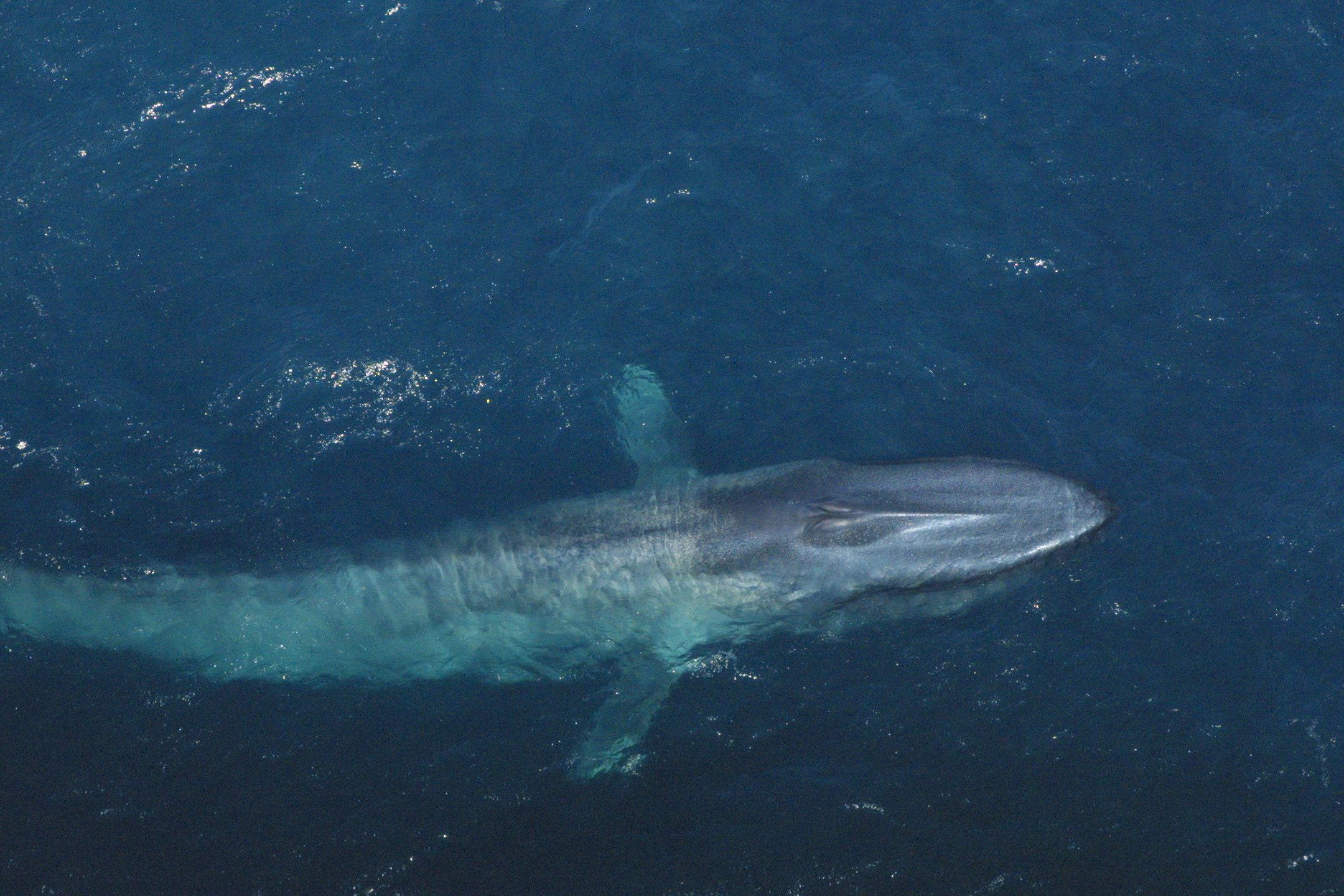
The blue whale is the largest animal ever, even bigger than the largest dinosaurs. Its spout can reach up to 10-12 m high, and its tongue alone weighs as much as a whole elephant, about 2,700 kg. Their hearts are the size of a small car, with arteries big enough for a human baby to crawl through.
There are five subspecies of blue whales, with the ones in Antarctica being the largest, growing up to 33.5 m long. As for most baleen whales, female blue whales are usually larger than males.
They need to eat a lot, up to 3,600 kg of krill every day. Newborn blue whales are born huge, already 6-7 m long and weighing 2,500 kg. They drink 200 l of milk and gain over 100 kg in weight each day.

Several hybrids of fin and blue whales have been seen and genetically confirmed. A hybrid is an offspring resulting from the crossbreeding of two different species. In 2013, one was caught in the Irminger Sea west of Iceland, followed by another in 2018. The 2018 specimen has been confirmed as a hybrid, with a fin whale father and a blue whale mother.

The situation of blue whales in the Faroe Islands
We are working on this.
The situation of blue whales in Greenland
We are working on this.
The situation of blue whales in Iceland
We are working on this.
The situation of blue whales in Norway
We are working on this.
The situation of blue whales in Denmark
We are working on this.
Adult length 28 metres
Adult weight 150,000 kg
Max age 90 years
Eats krill
Group size mostly solitary
Predators killer whales
IUCN status near threatened (2022)
NA abundance >3,000
The blue whale is protected globally
Sound credit: Léa Bouffaut, Cornell University