Even though white-beaked dolphins are built for cold water, can be very dangerous for them. Sometimes, shifting traps dolphins, making it hard or even impossible for them to reach the surface to breathe. Sadly, this can lead to drowning or being crushed by the ice. In Svalbard, one group of trapped dolphins was even eaten by polar bears [1]. Around Newfoundland, 29 of these ice entrapments were recorded between 1979 and 1991, with up to 350 dolphins killed during that time [2].
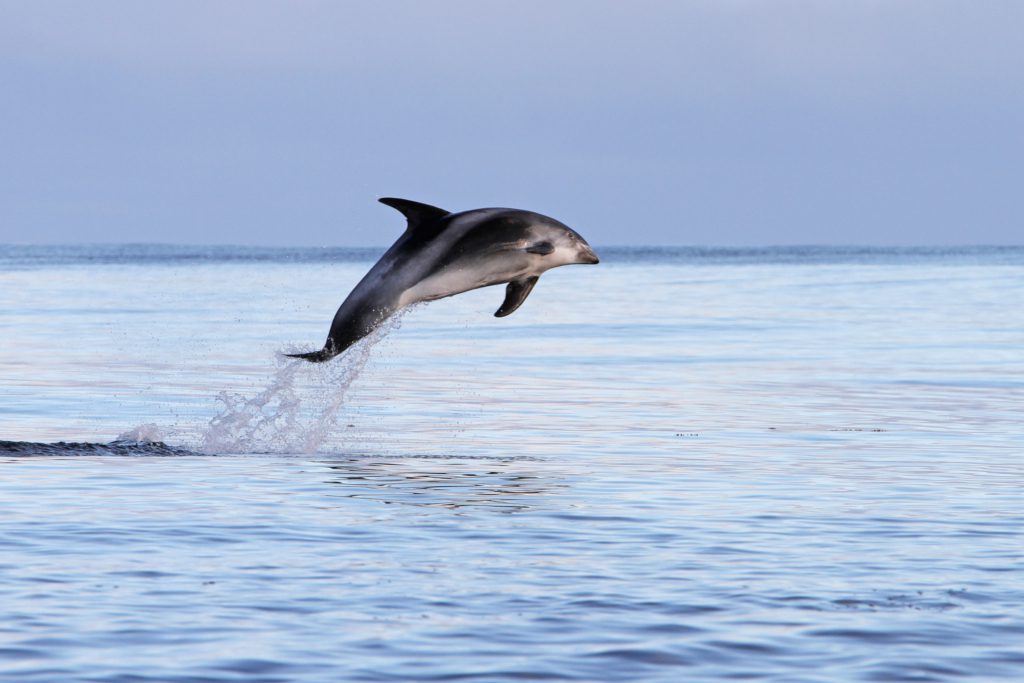
White-beaked dolphins are often seen riding the waves created by boats. While this ‘’ behaviour can help save energy [3,4], dolphins are often seen going back to where they started from [5], suggesting it is more about play than travel. White-beaked dolphins have even been seen harassing larger whales, such as fin whales, to swim faster and create a wave they can ride.
*Catches of white-beaked dolphin and white-sided dolphin are reported together in Greenland
[1] Aars, J., Andersen, M., Breniėre, A. et al. (2015).White-beaked dolphins trapped in the ice and eaten by polar bears. Polar Research, 34, 26612. http://dx.doi.org/10.3402/polar.v34.26612
[2] Dong, J. H., Lien, J., Nelson, D. et al. (1996). A contribution to the biology of the white-beaked dolphin, Lagenorhynchus albirostris, in waters off Newfoundland. Canadian Field-Naturalist,110, 278–287. https://doi.org/10.5962/p.357452
[3] Fiori, L., Davis, R.W., Würsig, B., & Orbach, D.N. (2024). Energetic savings of bow-riding dolphins. Scientific Reports, 14, 30056. https://doi.org/10.1038/s41598-024-81920-y
[4] Williams, T., Friedl, W., Fong, M., Yamada, R.M., Sedivy, P., & Haun, J.E. (1992). Travel at low energetic cost by swimming and wave-riding bottlenose dolphins. Nature 355, 821–823. https://doi.org/10.1038/355821a0
[5] Würsig, B., Thewissen, J. G. M., & Kovacs, K. M. (Eds.). (2017). Encyclopedia of marine mammals (3rd ed.). Academic Press. https://doi.org/10.1016/C2015-0-00820-6


 167* dolphins/year mean 2019-2023