- Nebbafiskur
- Langreyður
- Finnhval
- Fin whale
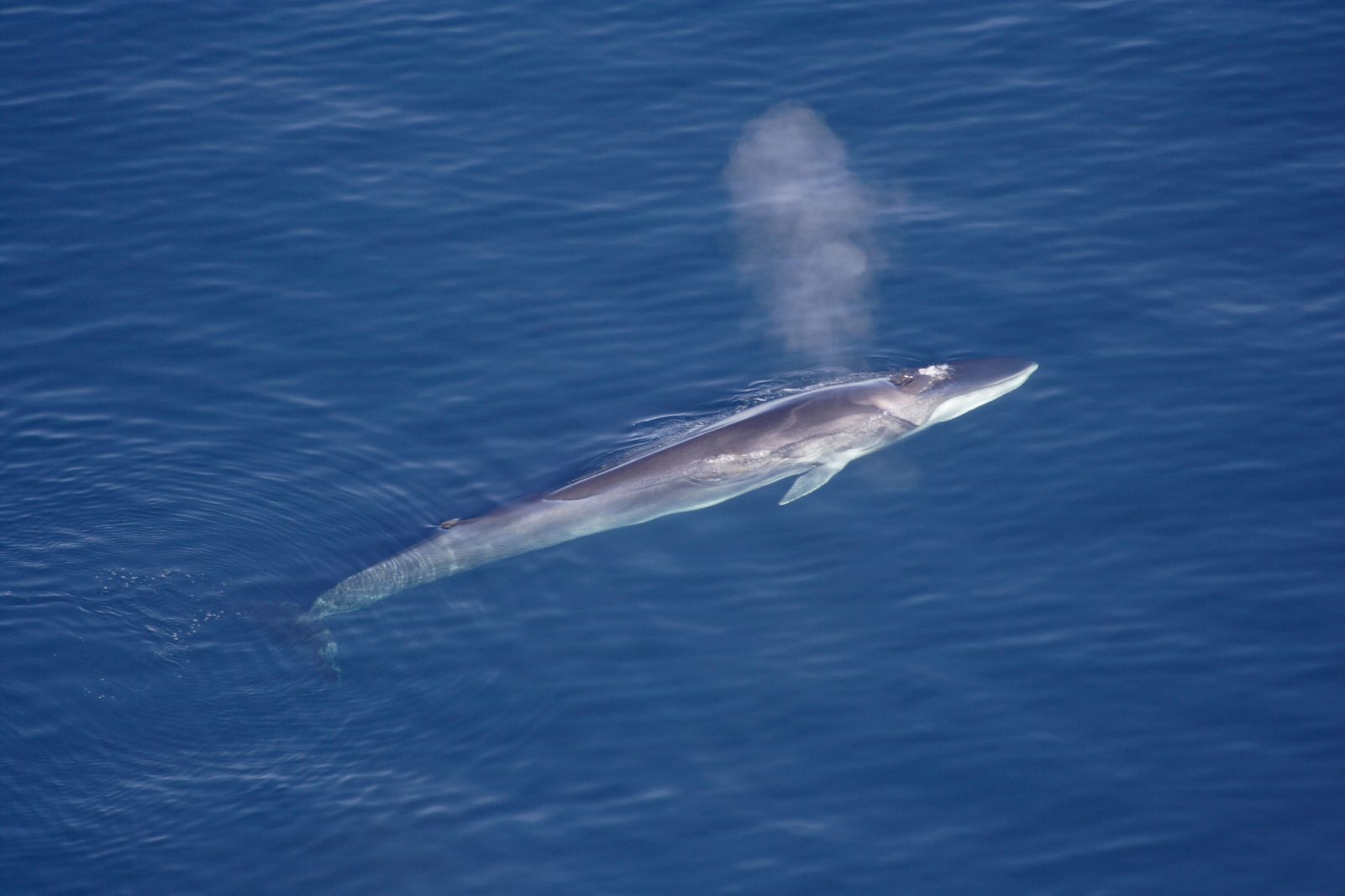
Finhvalen er verdens næststørste hvalart og findes i alle verdenshavene. Til havs kendes den let på den skarpe forhøjning mellem den buede rygfinne og halefinnen, som har givet den kælenavnet razorback på engelsk, “barberbladsryg”. Finhvaler lever som regel alene, men kan samle sig i store flokke i føderige områder. I Nordatlanten er der tydelige tegn på, at bestandene er i fremgang efter fortidens intensive hvalfangst.
Finhvalen har en asymmetrisk hovedfarve: Kæben er hvid i højre side, og mørk i venstre, hvilket muligvis virker som camouflage, når den jager. Den vender sig næsten altid om på højre side, når den spiser. Mange havdyr udnytter denne såkaldte modskygning: en mørk overside, der gør dem svære at se oppefra mod havets dyb, og en lys underside, der ligner lyset fra havoverfladen og camouflerer dem nedefra.

Forskere kan bestemme finhvalers alder ved at undersøge vokspropper i deres ører, som har vækstlag, ligesom træ har årringe. Finhvaler kan blive mindst 80-90 år gamle. De ældst kendte blev fanget ved Island og Antarktis og var henholdsvis 94 og 111 år.

Udvokset længde 21 meter
Udvokset vægt 70000 kg
Maksimal alder 90 år
Spiser krill og små fisk
Gruppens størrelse oftest alene i Nordatlanten
Rovdyr isbjørn, hvalros, spækhugger, Grønlandshaj
IUCN-status ikke truet (2022)
Forekomst i Nordatlanten 80,000
Jaget i
 9 hvaler/år gennemsnit 2019-2023
 60 hvaler/år gennemsnit 2019-2023
Lydkreditering: Heidi Ahonen, Norwegian Polar Institute
Forskning
På den internationale IUCN-rødliste er finhvalen klassificeret som sårbar. Men i den seneste vurdering fra den europæiske IUCN-rødliste fra 2023 står den som ikke truet. Hvad er forskellen på disse lister, og hvordan fastlægges status?
Did you know that fin whale calls can help to study the environment they inhabit?
Fin whale vocalizations can reach up to 189 dB (1mPa at 1 m) which makes them one of the strongest among the animal calls in the ocean. The noise of the call is comparable to that produced by large ships and can be monitored- hundreds of miles away from the source. One call type lasts 1 second with a dominant frequency of around 20 Hz. These calls are repeated every 7 to 40 seconds producing songs that last up to tens of hours, with short interruptions about every 15 min when the whale surfaces. These calls are frequently captured by Ocean-bottom seismometer (OBS) stations which are deployed for earthquake monitoring and are set to record vibrations of 50 Hz and lower. When a fin whale call impinges on the ocean bottom, a part of the call energy is transmitted in the ground as a seismic wave. The seismic wave travels through the oceanic crust, where it is reflected and refracted by layers within the crust. Kuna & Nábělek used the recorded fin whale calls which contained the signals reflected and refracted from crustal interfaces for seismic imaging of the oceanic crust. Fin whale vocalisations were recorded at 3 OBS stations in the northeast Pacific Ocean from 2012 to 2013 and 6 songs with durations ranging from 2.5 to 4.9 hours were analysed. The three studied sites show consistent results, agreeing with regional and global observations, and demonstrate that fin whale calls can be used for seismic imaging. Interestingly, yawning in aquatic species, like belugas, is intriguing because they don't breathe through their mouths, as fully aquatic mammals have a separate trachea and esophagus. Nevertheless, the open mouth behaviour displayed by beluga whales during certain events has been described as "yawn-like" due to its resemblance to yawning in terrestrial mammals.
But why do belugas yawn, and what triggers this behaviour? The function of yawning in animals, including belugas, remains somewhat mysterious. In humans, yawning has been associated with various factors such as sleepiness, respiration and circulatory needs, boredom, arousal, empathy, and thermoregulation. The observation of Ames (2022) raises questions about whether belugas, with their social and imitative abilities, may have the capacity to imitate human motor movements.
Read the full observation by Ames (2022) here:
https://doi.org/10.1578/AM.48.6.2022.495
Did you know that some nerves of rorqual whales are like bungee cords?
The members of rorqual whales (Balaenopteridae) are easily to distinguish from other baleen whales by long furrows stretching from the mouth along the throat to the navel. Some members of this family are the blue (Balaenoptera musculus) and the fin whale (Balaenoptera physalus) which are the biggest animals on earth. One potential reason of their size is their ability to lunge feed, which is a unique feeding style for rorquals. The animals swim with an open mouth, which in this position is almost vertical to the rostrum, to flood it with amounts of water and krill which can be greater than the whale itself. During this process the furrowed skin expands immensely, meaning that the nerves in this skin must be highly endurable to this movement. Vogl et al. studied these nerves from fin whale carcasses in Iceland. They found that the nerves can double their length and can return to normal length without a problem. The secret behind this “bungee cord” behaviour are folded nerve fibre fascicles concentrated in a small core of the nerve and a thick wall of elastin fibres and highly folded collagen fibres around it. During a lunge, the core nerve fibres and collagen fibres unfold while the elastin fibres stretch. The collagen fibres become taut to prevent overstretching, thus the nerves are not really stretched but the fascicles unfold while the whole nerve just increases in length. In general, nerves are not very extensible like this and ‘nerve stretch injury’ is the most common type of nerve trauma in humans. Therefore, these highly extensible nerves could be one of the most important functions in rorquals which enabled the evolution of these large whales.The discovery of the Charlotte whale, as the Vermont’s fossil is known, helped to explain the geology and glacial history of North America. Thanks to this and other marine fossils and sediments found in the region, we now know that portions of Ontario and Quebec (Canada) and the US states of Vermont and New York were not so long ago covered by the Champlain Sea, an arm of the Atlantic Ocean that once extended from the Gulf of St. Lawrence to the Great Lakes. The Champlain Sea was short-lived and formed when the ice retreaded from this area 13,000 years ago, leaving a deep basin that was filled with water from the Atlantic Ocean and became populated by marine mammals such as belugas, fin whales, bowhead whales and walruses. Free from the pressure of tons of ice, the earth crust slowly rebounded until, 3000 years later, the land was again above the sea level, the connection with the Atlantic Ocean closed and the basin transformed into the freshwater river valley it is today.
Did you know that...
The fin whale (Balaenoptera physalus), the second largest animal of the planet, is a lunge-feeder, meaning it swims with an open mouth to flood it with amounts of water and krill which can be greater than itself. After the water is filtered out through the baleens, the krill can be swallowed. But how do these whales keep their digestive and reparatory tract separated and protected to not drown on the water? Biopsies conducted by Gil et al. of fin whales from Icelandic waters have shown that an “oral plug” in its relaxed form is protecting the digestive tract. It consists of fat and muscle tissues, is a distinct part of the soft palate and must be lifted to swallow prey. When lifted, it blocks and protects the upper airways. This mechanic is described to be crucial for the evolution of lunge feeding and therefore the large body sizes of lunge-feeding whales.
Did you know that the fin whale (Balaenoptera physalus) is the fastest swimming baleen whale?
The fin whale is the second-largest living animal in the world, second in size only to the blue whale. Adults fin whales grow to sizes of around 20 metres, with females being slightly longer than males. Despite this incredible size, they are the fastest swimming baleen whale, reaching gaining speeds of up to 90 km/h. How can such a large whale achieve such great speed? Well, they have developed some adaptations that allow them to do that. Fin whales, out of all rorquals—the largest group of baleen whales, including blue whale, sei whale, humpback whale, common minke whale and others—have the most streamlined body shape, with a slender, elongated body and a tapered head. This shape allows them to move effortlessly through the water by minimising water resistance. Additionally, they have strong tail muscles that can propel them with great force.
But why do belugas yawn, and what triggers this behaviour? The function of yawning in animals, including belugas, remains somewhat mysterious. In humans, yawning has been associated with various factors such as sleepiness, respiration and circulatory needs, boredom, arousal, empathy, and thermoregulation. The observation of Ames (2022) raises questions about whether belugas, with their social and imitative abilities, may have the capacity to imitate human motor movements.
Read the full observation by Ames (2022) here:
https://doi.org/10.1578/AM.48.6.2022.495