- Kigutilissuit
- Búrhvalur
- Spermasetthval
- Kaskelohttas
- Kaskelothval
- Sperm whale

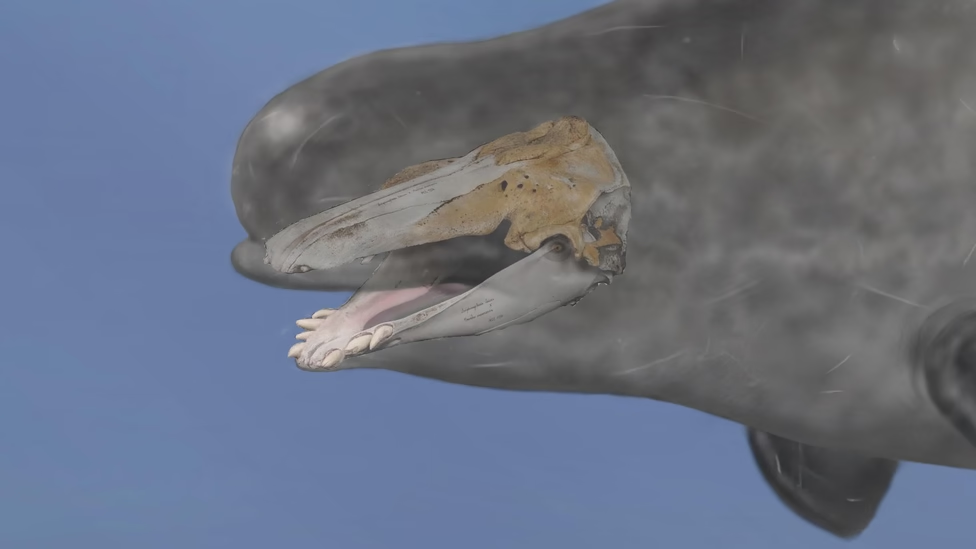
Avgusturin er tann størsti tannhvalurin og størsta ránsdjórið, sum finst. Hann hevur ein langan, mjáan undirkjaft við umleið 25 tonnum hvørjumegin, men ongar tenn í yvirkjaftinum. Avgusturin heldur til í heimshøvunum frá tropunum og til ískantin. Teir eru kendir fyri, hvussu leingi og hvussu djúpt, teir kava. Teir fara niður á 2000 metra dýpi og kunnu vera undir í tveir tímar. Teir eta fyri tað mesta djúphavshøgguslokk, og teirra stóra, fýrakantaða høvd fær ofta arr av at berjast við høgguslokkin. Avgusturin hevur tann størsta heilan av øllum djórum; hann vigar upp móti 9 kg!


The situation of sperm whales in the Faroe Islands
We are working on this.
The situation of sperm whales in Greenland
We are working on this.
The situation of sperm whales in Iceland
We are working on this.
The situation of sperm whales in Norway
We are working on this.
The situation of sperm whales in Denmark
We are working on this.
Ljóðheiti: Andenes Whale Research
Gransking
Read the full study by Vachon et al. (2022) here:
Read the study by Glarou et al. here:
Sperm whales communicate using socially learned patterns of clicks, so called codas, which can vary in number of clicks, rhythm and tempo, thus generating different coda types. Based on variations of coda types, also called dialects, sperm whale populations are divided into behaviorally distinct clans. Within these clans, sperm whales in the Pacific Ocean make distinct vocalizations that help them identify whales in different clans. These “identity codas” are seen as symbolic markers—seemingly arbitrary traits that function as indicators of cultural group membership to others. For example, you wear a t-shirt of your favorite band, then you show everyone in which group you belong, and everyone can identify you as a member of it. Moreover, identity codas were used more often when multiple clans were present and less observed when a clan was isolated. Meaning sperm whales adjust their vocal behavior to reaffirm their cultural identity in areas of high spatial overlap. Identity codas function as symbolic markers of clan identity and prove the existence of whale culture because they are shared among clan members, learned and passed down through generations via social learning. The study by Hersh et al. classified 23,429 codas collected from 23 locations in the Pacific Ocean from 1978-2017. The researchers were able to name 3 additional clans to the already 4 known in the Pacific Ocean.
Read the study by Hersh et al. here: https://www.pnas.org/doi/10.1073/pnas.2201692119
When a 13.7 m long and 8 t heavy sperm whale washed ashore in Florence, Oregon in 1970, the Highway Division was assigned the disposal of the carcass. Due to its size, the divisions plan was to use half a ton of dynamite to basically disintegrate the whale and have scavengers feed on the rest. The dynamite was placed so the remains would be blown towards the sea. In the moment of truth however, the explosion did not have the wished effects as big pieces of blubber flew everywhere, spectators had to flee the scene and a car 400 m away got destroyed by a big piece of blubber. You can watch the original news report here. Today, several methods are used to manage whale carcasses which do not include dynamite, from natural decomposition in situ to disposal at a local landfill, incineration or rendering. Martina Quagiotto et al. looked at how stranded whales are handled around the world and the ecosystem services whale carcasses provide. They play a crucial role in coastal systems therefore natural decomposition in situ whenever possible is recommend to maximise ecosystem functions and minimise economic costs.
You can find the study here:
https://www.sciencedirect.com/science/article/pii/S221204162200002X