- Natsersuaq
- Blöðruselur
- Klappmyss
- Ávjjur
- Klapmyds
- Hooded seal
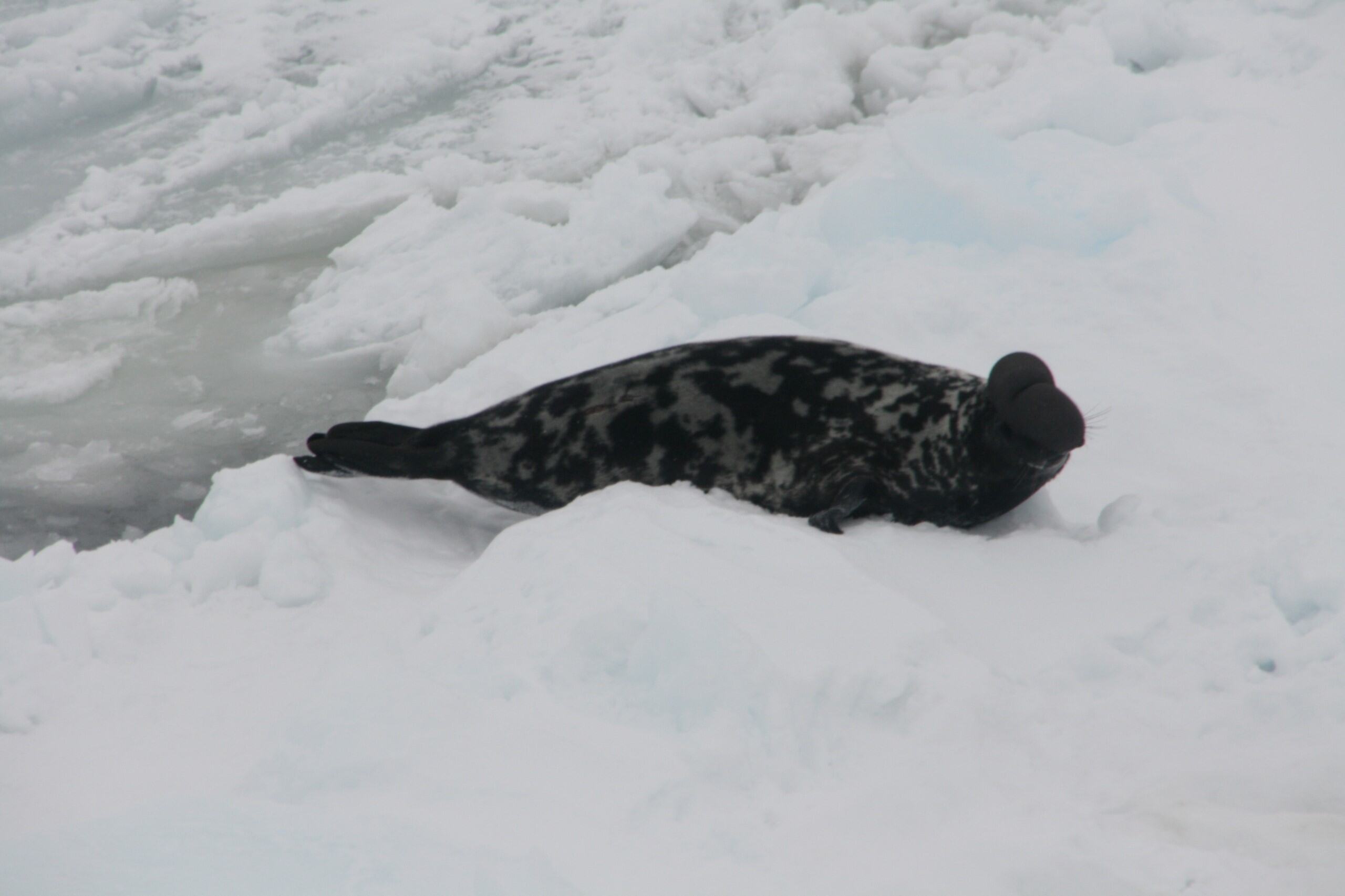
Hooded seals are the largest true seal species in the North Atlantic. Like a lot of animals, they show sexual dimorphism. Males can grow up to 2.5 metres and weigh 300 kg, while smaller females grow up to 2.2 metres and weigh around 160 kilograms. Adults have characteristic silvery-grey coat with irregular spots all over their bodies and dark coloured flippers and faces. Pups are born with their distinctive blue-grey coats on their backs and lighter bellies. Because of this colouration, they got their nickname “blueback”.


The situation of hooded seals in the Faroe Islands
We are working on this.
The situation of hooded seals in Greenland
We are working on this.
The situation of hooded seals in Iceland
We are working on this.
The situation of hooded seals in Norway
We are working on this.
The situation of hooded seals in Denmark
We are working on this.
 1,112 kópur/ár miðaltal fyri 2019-2023
 10 1,112 kópur/ár miðaltal fyri 2019-2023
Ljóðheiti: Heloise Frouin-Mouy, JASCO Applied Sciences & Mike Hammill, DFO
Hóttanir
Gransking
The name hooded seals comes from the distinctive hood that males sport. It is usually displayed during the breeding season to attract mates. But what is this hood? It is the nasal sac—air-filled empty spaces on either side of the nasal cavity—which can be inflated to form a bi-lobed hood over the top and front of the head. In addition to their hood, they also have elastic nasal septum—structure in the midline that divides the right and left nasal cavities— which can also be inflated and looks like a pink balloon.
While nursing their pups, female hooded seals are frequently surrounded by one to several males who compete with one another for a mate. This competition consists mainly of display, with males repeatedly inflating their bi-lobed “hoods” and nasal septums. While the competition is usually just displays, it can also involve fighting one another. Because this hood is used in attracting the females, it can be considered secondary sexual characteristics.
Interestingly, yawning in aquatic species, like belugas, is intriguing because they don't breathe through their mouths, as fully aquatic mammals have a separate trachea and esophagus. Nevertheless, the open mouth behaviour displayed by beluga whales during certain events has been described as "yawn-like" due to its resemblance to yawning in terrestrial mammals. But why do belugas yawn, and what triggers this behaviour? The function of yawning in animals, including belugas, remains somewhat mysterious. In humans, yawning has been associated with various factors such as sleepiness, respiration and circulatory needs, boredom, arousal, empathy, and thermoregulation. The observation of Ames (2022) raises questions about whether belugas, with their social and imitative abilities, may have the capacity to imitate human motor movements. Read the full observation by Ames (2022) here: https://doi.org/10.1578/AM.48.6.2022.495