- Aaveq
- Rostungur
- Hvalross
- Morša
- Hvalros
- Atlantic walrus


The situation of walrus in the Faroe Islands
We are working on this.
The situation of walrus in Greenland
We are working on this.
The situation of walrus in Iceland
We are working on this.
The situation of walrus in Norway
We are working on this.
The situation of walrus in Denmark
We are working on this.
 53 roysningur/ár miðaltal fyri 2019-2023
Ljóðheiti: Christian Lydersen, Norwegian Polar Institute
Hóttanir
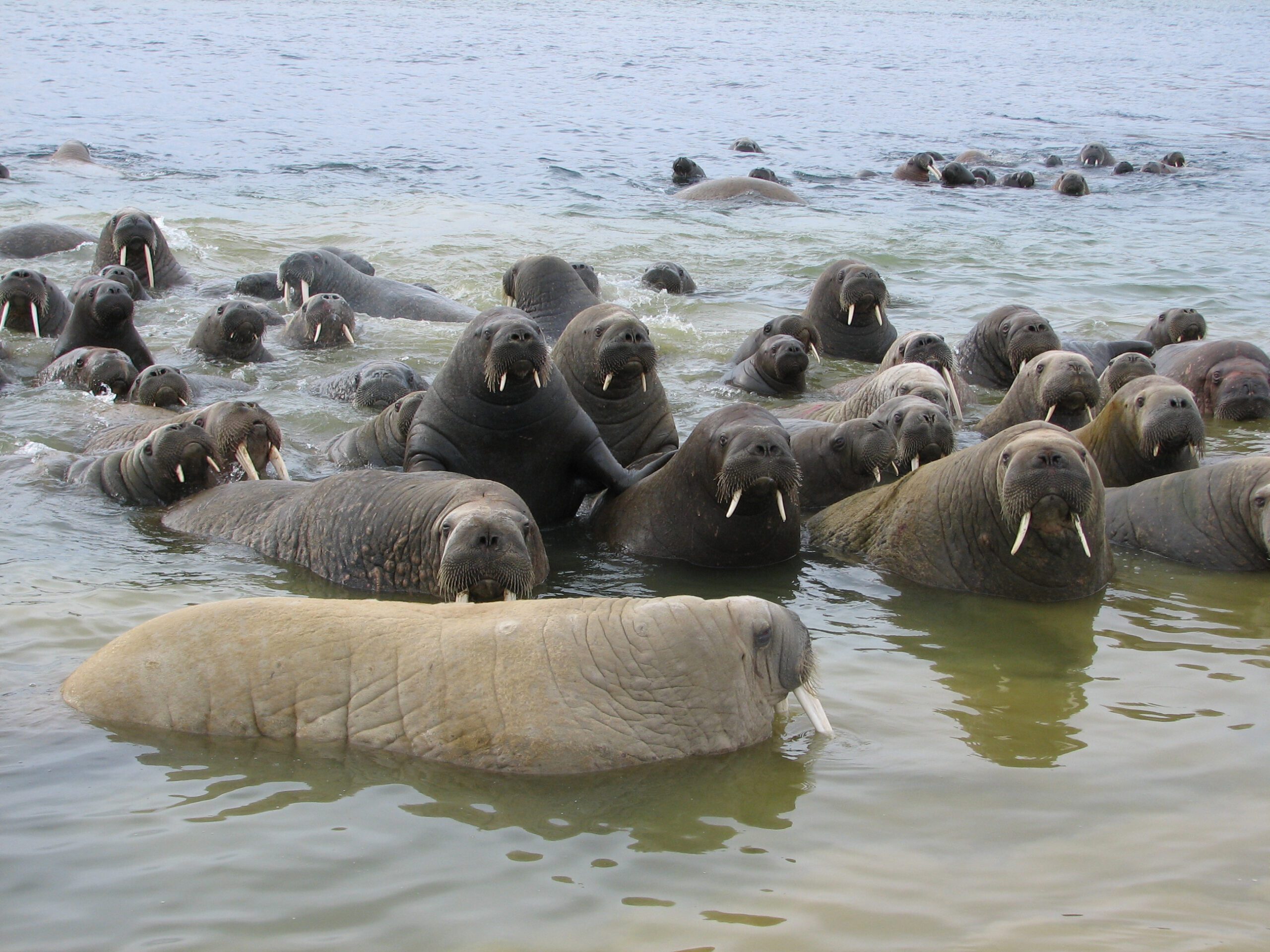
Walruses are one of the largest species of pinnipeds (the group that contains all types of seals and walrus) and is the largest member of this group to live in the Arctic. One of the most recognisable features of these animals are tusks, two modified upper canines—relatively long, pointed teeth. Both males and females grow tusks throughout their life, and these tusks may grow up to one metre.
Walruses use these tusks as a multi-functional tool: to help them climb up on ice, fight predators, and threaten and fight each other. Walruses use their tusks to sift through the seabed when searching for food. They also use these to help them stay afloat when sleeping in the water. They hang onto ice with their tusk to stay above the water surface so that they can keep breathing while sleeping.
All walrus populations were overhunted historically; most are recovering following complete protection or quota-based hunting. The greatest threat for walruses today is climate change and its associated impacts on sea ice. Changes in sea ice alter their habitat and expose them to increased human activity. In addition, with changing sea water acidity, bivalves—the main prey of walruses—may be impacted, which can cause changes in the walrus diet.
Did you know that despite being Arctic animals walruses can travel long distances?
On Saturday 11th of June 2022, a young walrus was found lying asleep on a leisure boat in the coastal town of Kragerø, in Southern Norway. The surprised residents called the local fire brigade, who got the animal out of the boat, but as it kept swimming back, it was decided to allow the unexpected visitant to lie there. Later, the coast guard cordoned off the area to protect it from people, and by Sunday morning, the walrus was gone.
Walruses have a circumpolar distribution (this is, they are distributed in areas around the poles) including Norway, but they are not usually found in the mainland. Instead being year-round in the Norwegian Arctic Archipelago of Svalbard, thousands of kilometres away from Kragerø. Walruses can sometimes disperse long distances and end up in places far away from their natal sites, with records existing from latitudes further south, such as another young individual being spotted in the coastal city of Bilbao (Basque Country) in 2021.
Gransking
Roysningur hevur vanliga ein kanelbrúnan lit, men viðhvørt síggja teir út til at hava ein ljósareyðan lit. Hvussu ber tað til?