- Arfivik
- Grænland hvalur
- Grønlandshval
- Grønlandshval
- Bowhead whale
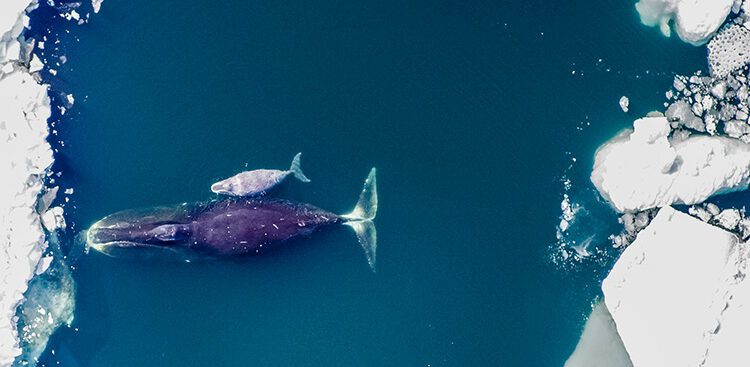


The situation of bowhead whales
Bowhead whales are not present in Faroese waters.
The situation of bowhead whales in Greenland
Bowhead whale populations were severely reduced by centuries of industrial whaling. Today, the Eastern Canada–West Greenland of bowhead whales stock is increasing, and there are signs of growth in the East Greenland–Svalbard–Barents Sea stock. On the Greenlandic National Red List the East Canada-West Greenland stock as “Near Threatened“, and the East Greenland-Svalbard-Barents Sea stock as “Vulnerable”.
Subsistence hunting by Inuit communities in Canada, Greenland, and Alaska continues under strict regulations. In Greenland, the East Canada-West Greenland stock is the only one currently hunted. Annual quotas are set domestically in Canada and by the International Whaling Commission for Greenland and Alaska.
The situation of bowhead whales in Iceland
Bowhead whales could be present in waters north of Iceland. Bowhead whales are protected in Iceland.
The situation of bowhead whales in Norway
Bowhead whales are protected in Norway, and therefore the East Greenland-Svalbard-Barents Sea, believed to not be very numerous is not hunted.
The situation of bowhead whales in Denmark
Bowhead whales are not present in Danish waters.
 0.2 hvalir/ár miðaltal fyri 2019-2023
Ljóðheiti: Outi Tervo, Greenland Institute of Natural Resources
Gransking
Fyri at eyðmerkja einstøk djór, nýta vísindafólk merkingar á serstøkum pørtum á teimum ymsu hvalasløgunum. T.d. verður hornið brúkt á springarum, og á kúlubøkum er tað sveivin, ið verður merkt. Hvussu gera teir við grønlandshvalin?
✔️ Answer: The bowhead whale!
Weapon fragments from the 19th century used for whale hunting were discovered in bowhead whales in Alaska in 2007. Combined with an age-estimation technique that analyses proteins present in the eye lenses of these creatures, scientists revealed that some bowheads may live for more than 200 years! This information is not just fascinating: it is also crucial for the conservation of these great creatures. Marine mammals in the high north face heightened challenges due to climate change and human activities. Comparing longevity in the past and the present helps us evaluate how these threats affect them today.
Interestingly, yawning in aquatic species, like belugas, is intriguing because they don't breathe through their mouths, as fully aquatic mammals have a separate trachea and esophagus. Nevertheless, the open mouth behaviour displayed by beluga whales during certain events has been described as "yawn-like" due to its resemblance to yawning in terrestrial mammals. But why do belugas yawn, and what triggers this behaviour? The function of yawning in animals, including belugas, remains somewhat mysterious. In humans, yawning has been associated with various factors such as sleepiness, respiration and circulatory needs, boredom, arousal, empathy, and thermoregulation. The observation of Ames (2022) raises questions about whether belugas, with their social and imitative abilities, may have the capacity to imitate human motor movements. Read the full observation by Ames (2022) here: https://doi.org/10.1578/AM.48.6.2022.495