Ljóðórógv
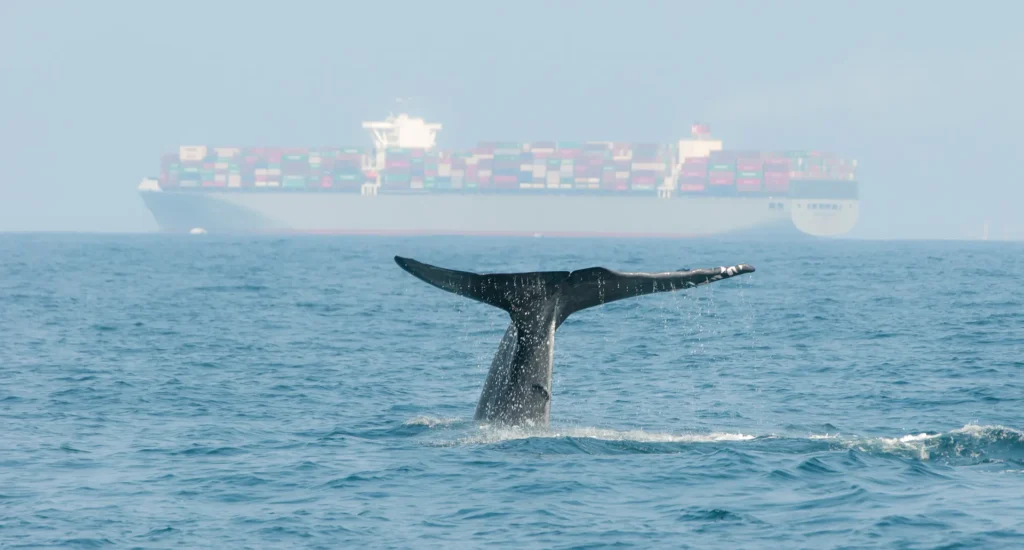
Marine mammals use sound for communication, navigation, and hunting. Human activities like shipping, fishing, oil and gas exploration and marine military activities, marine renewable energy production, and recreational water activities produce noise and can disrupt marine mammals. These disturbances can interfere with the animals’ natural behaviours, like feeding, caring for their young, socialising, resting, and migrating. As a result, individual fitness and survival rates may decrease.

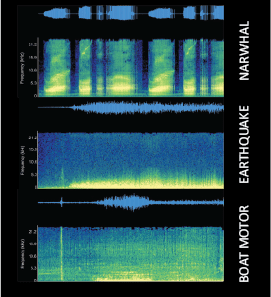
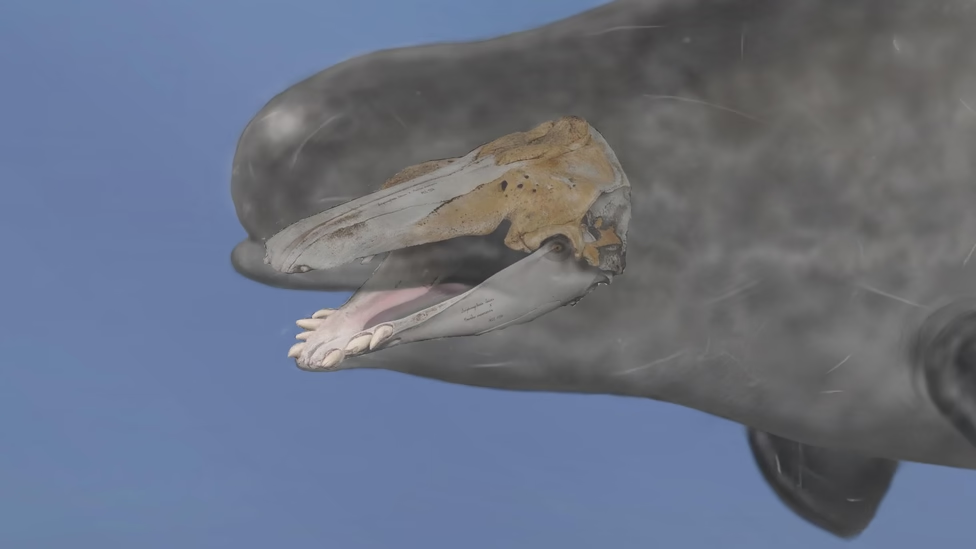
The underwater soundscape of the Arctic is becoming increasingly noisy as a consequence of climate change. As the sea ice decreases and thins, previously inaccessible areas are opening up to human activities, contributing to increased noise pollution [1]. This noise can significantly disrupt marine mammals, particularly species that are sensitive to sound, such as narwhals. Research has shown that narwhals, typically deep-divers, reduce their foraging activity and shift to shallower depths when exposed to human-made noise [2]. Other deep-diving species, like beaked whales, may react negatively to impulsive noise causing them to resurface too quickly and suffer decompression sickness [3].

References
[1] Huntington, H. P., Boyle, M., Flowers, G. E., Weatherly, J. W., Hamilton, L. C., Hinzman, L., Gerlach, C., Zulueta, R., Nicolson, C., Overpeck, J. (2007). The influence of human activity in the Arctic on climate and climate impacts. Climatic change 82, 77–92. https://doi.org/10.1007/s10584-006-9162-y
[2] Tervo, O. M., Blackwell, S. B., Garde, E., Hansen, R. G., Samson, A. L., Conrad, A. S., Heide-Jørgensen, M. P. (2023). Stuck in a corner: Anthropogenic noise threatens narwhals in their once pristine Arctic habitat. Science Advances 9, eade0440. https://doi.org/10.1126/sciadv.ade0440
[3] Jepson, P., Arbelo, M., Deaville, R. et al. Gas-bubble lesions in stranded cetaceans. Nature 425, 575–576 (2003). https://doi.org/10.1038/425575a
Did you know that...
- For the average human ear, only sound signals between 20 Hertz and 20,000 Hertz are audible. In contrast, the range of sounds and signals emitted and detected by marine mammals spans a much broader spectrum, from 7 Hertz to 160,000 Hertz, showing the higher sensitivity of marine mammals to noise.
- Disturbance may affect individuals and be a welfare issue, but it may also have effects at the population level.
- While noise is still a challenge for management, once we stop emitting noise, it will be gone immediately, unlike other threats like pollution that take decades to degrade and thus, to mitigate.